

Digital Transformation Framework

Digital transformation is not paper replaced by software. It changes the way the institution works.
Purpose
Digital transformation is not paper replaced by software.
Successful transformation requires understanding how an institution works, why a process exists, which information it depends on, who participates in it and how technology can improve the process without disrupting institutional responsibility.
The ITO Digital Transformation Framework provides a structured methodology for designing and implementing digital transformation initiatives in government, public safety and other complex institutional environments.
The framework combines business analysis, process transformation, technology architecture, interoperability, security, data governance, implementation and continuous improvement into a single delivery model.
One delivery model
- Business analysis
- Process transformation
- Technology architecture
- Interoperability
- Security
- Data governance
- Implementation
- Continuous improvement
Document control
- Document ID
- ITO-DTF-001
- Version
- 1.0
- Classification
- PUBLIC
- Owner
- Strategy and Engineering
- Review cycle
- Annual
- Published
- October 2026
Its purpose is simple
Transform the process first. Digitise it second.
Why projects fail
They begin with technology
Public-sector digitalisation projects often begin with technology. The result may be technically functional without creating meaningful transformation.
The technology-first pattern
- A software platform is selected
- Requirements are written around existing administrative procedures
- The existing process is transferred into a digital interface
- Technically functional. Not transformed.
ITO takes a different approach
Before deciding what to build, we seek to understand:
- 01 What problem are we solving?
- 02 Who participates in the process?
- 03 Where are the delays and unnecessary steps?
- 04 Which information already exists elsewhere?
- 05 Which decisions require institutional authority?
- 06 What can safely be automated?
- 07 Which systems must communicate?
- 08 How will success be measured?
Technology comes after these questions.
The framework
Seven phases. Five foundations.
The seven phases describe how we transform. The five foundations describe what every transformation must rest on.
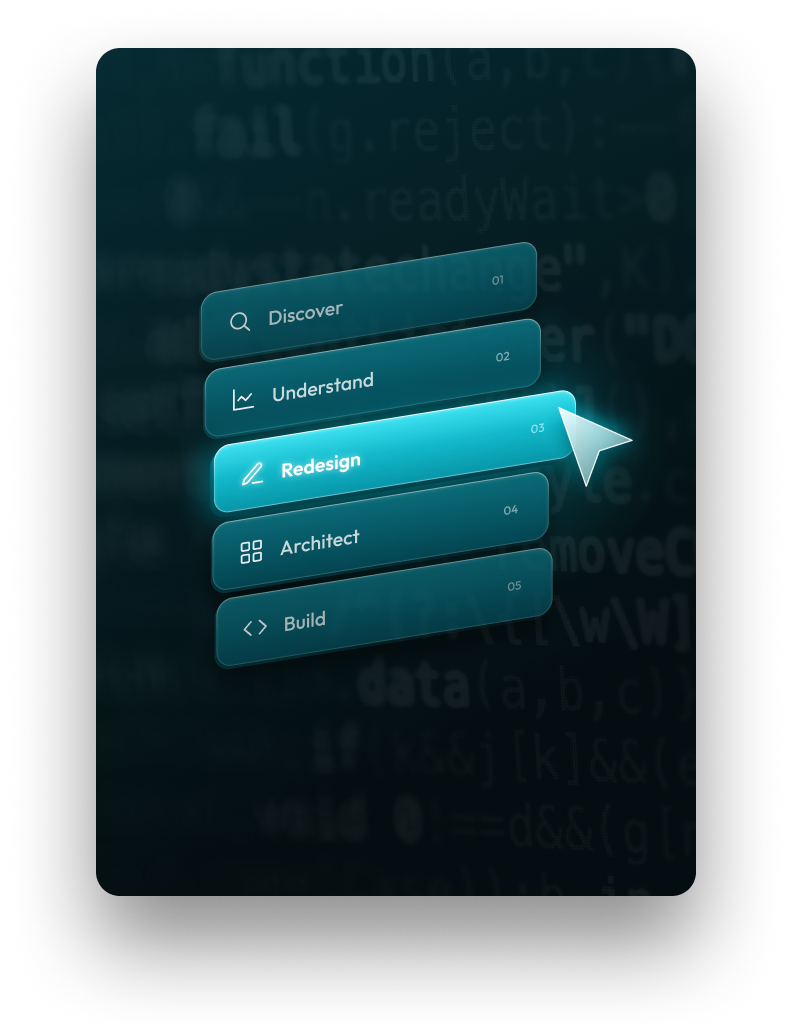
The ITO Digital Transformation Framework
- 01
Discover
Start with the institutional challenge.
Transformation Brief
- 02
Understand
Understand the process before changing it.
AS-IS Model
- 03
Redesign
Do not digitise inefficiency.
TO-BE Model
- 04
Architect
Design the digital ecosystem.
Solution Architecture
- 05
Build
Engineering the transformation.
Production-Ready Service
- 06
Adopt
Not finished at go-live.
Operational Adoption
- 07
Evolve
Digital transformation is continuous.
Continuous Improvement
-
Continuous cycle back to Understand and Redesign
Continuous foundations across all phases
- 01 Trust
- 02 Security
- 03 Data
- 04 Interoperability
- 05 Governance
Discover
Start with the institutional challenge
Every transformation begins with a problem, not a product.
The objective of the Discovery phase is to establish the institutional context and understand why transformation is needed.
We examine
- 01 Strategic and operational objectives
- 02 Existing services and processes
- 03 Stakeholder expectations
- 04 Regulatory and organisational constraints
- 05 Existing technology landscape
- 06 Known operational problems
- 07 Expected outcomes
The Transformation Brief defines
- 01 Current situation
- 02 Problem
- 03 Objectives
- 04 Stakeholders
- 05 Constraints
- 06 Expected outcomes
At this stage, no product is selected. The problem is defined first.
Understand
Understand the process before changing it
Complex institutional processes cannot be transformed from a technical specification alone.
ITO works with operational stakeholders to understand how processes function in practice. The analysis may cover:
- People ? Who performs each activity?
- Processes ? How does work move through the institution?
- Information ? What information is required and where does it originate?
- Systems ? Which existing technologies support the process?
- Decisions ? Where is institutional judgement required?
- Bottlenecks ? Where do delays, duplication or manual work occur?
- Dependencies ? Which external institutions or systems participate?
Redesign
Do not digitise inefficiency
A bad process does not become a good process simply because it becomes digital.
The Redesign phase challenges unnecessary steps, duplicated information, manual transfers and disconnected systems. The objective is to design the future process before implementing the technology.
Typical interventions, in order
- 01 Eliminate Unnecessary steps
- 02 Simplify Complex workflows
- 03 Integrate Disconnected information sources
- 04 Automate Repetitive activities, where appropriate
- 05 Standardise Processes and information
- 06 Digitise Remaining interactions
Digitisation is the last intervention, not the first.
From AS-IS to TO-BE
The transformation is designed as a change in how the service works, not only in the medium through which it is delivered.
Current process · AS-IS
- Citizen
- Counter
- Paper Registry Archive
- Officer
Transformed process · TO-BE
- Citizen
- Digital service Workflow Authoritative registers
- Institution
- Digital decision / service
Architect
Design the digital ecosystem
Transformation rarely requires a single isolated application.
Government services operate within ecosystems involving registries, identity systems, payments, document management, GIS, sensors, external institutions and legacy applications. ITO therefore designs the architecture around the transformed process.
- Registries
- Identity systems
- Payments
- Document management
- GIS
- Sensors
- External institutions
- Legacy applications
Key principles
-
Interoperability first
Reuse authoritative information through controlled integrations where possible.
-
Modular architecture
Systems can evolve without replacing the entire platform.
-
Institution-controlled governance
Technology operates within institutional roles, permissions, policies and authority.
-
Security & privacy by design
Security and data governance are architectural requirements, not post-deployment additions.
-
Vendor independence
Where practical, architecture should rely on documented interfaces and interoperable technologies rather than unnecessary proprietary dependencies.
Build
Engineering the transformation
Once the process and architecture are defined, implementation begins.
Reusable digital platforms
Proven platform capabilities
Project-specific engineering
Adapted to the institution
Faster, fitted implementation
Accelerated delivery, adapted to institutional requirements
ITO combines reusable digital platforms with project-specific engineering to accelerate implementation while adapting technology to institutional requirements.
The Build phase includes
- 01 Configuration Existing platform capabilities.
- 02 Integration Connection with institutional systems.
- 03 Development Project-specific functionality.
- 04 Migration Existing information where required.
- 05 Verification Functional, integration and security testing.
- 06 Deployment Controlled introduction into the target environment.
Adopt
Transformation is not finished at go-live
A technically successful system can still fail if users do not adopt it.
ITO therefore treats organisational adoption as part of implementation. This may include:
- 01 User training
- 02 Administrator training
- 03 Operational documentation
- 04 Phased rollout
- 05 Pilot deployments
- 06 User feedback
- 07 Workflow adjustments
- 08 Support during transition
The goal
Not
Software deployed
But
New process operational
Evolve
Digital transformation is continuous
A digital platform must therefore be capable of evolving after implementation. ITO supports an iterative model:
Everything changes
- Institutions
- Legislation
- Technology
- Citizen expectations
- Security threats
Improvements may include
- New services
- Additional integrations
- Workflow optimisation
- Automation
- Analytics
- Emerging technologies such as AI
Iterative model
- Operate
- Measure
- Learn
- Improve
The five foundations
What every transformation rests on
The seven phases describe how we transform. The five foundations describe what transformation must rest on.
- 01 Discover
- 02 Understand
- 03 Redesign
- 04 Architect
- 05 Build
- 06 Adopt
- 07 Evolve
-
01
Trust
Technology must operate within clearly defined institutional authority and accountability.
-
02
Security
Security must be considered throughout architecture, engineering, deployment and operation.
-
03
Data
Information should have defined purpose, governance and authoritative sources.
-
04
Interoperability
Digital services should connect institutions and systems rather than create new information silos.
-
05
Governance
Roles, responsibilities, processes and decision-making authority must remain clearly defined.
Foundation of every phase
Digitisation vs transformation
Changing the medium vs changing the work
| Digitisation | Digital transformation |
|---|---|
| Paper form → PDF | Redesign the service |
| Manual entry → web form | Reuse authoritative data |
| Standalone application | Integrated ecosystem |
| Existing workflow in software | Optimised workflow |
| Technology-focused | Outcome-focused |
| Project ends at deployment | Continuous improvement |
| Software as objective | Better public service as objective |
Digitalisation changes the medium. Digital transformation changes the way the institution works.
Technology as an enabler
Reusable foundations for transformation
ITO platforms provide reusable technological foundations that can accelerate different transformation initiatives. For example:
-
RENATA
Digital transformation of law-enforcement and public-safety processes.
-
eCTZen
Digital public services and citizen interaction.
-
eAppointment
Digital appointment and service-access management.
-
CollaBIZ GOV
Digital workplace and institutional collaboration.
-
AssetiX
Digital asset-management processes.
-
eVa
Digital management and enforcement of mobility-related fees and permissions.
-
AURA
IoT-enabled environmental and operational monitoring.
Measuring transformation
Outcomes, not installations
Transformation should produce measurable operational outcomes, not only implemented software.
Depending on the project, indicators may include:
- 01
Time
Reduced processing time.
- 02
Steps
Fewer manual activities.
- 03
Data
Reduced duplicate entry.
- 04
Access
Increased digital availability.
- 05
Integration
Increased reuse of authoritative information.
- 06
Quality
Reduced processing errors.
- 07
Transparency
Improved process traceability.
- 08
Adoption
Actual use of digital services.
- 09
Efficiency
Increased institutional capacity.
- 10
Experience
Improved user or citizen interaction.
Not the measure of success
Software implemented
The measure of success
Better institutional outcomes
The ITO transformation model
The whole framework in one formula
- 01 Understand the institution
- 02 Redesign the process
- 03 Connect the data
- 04 Engineer the platform
- 05 Enable the people
- 06 Measure the outcome
- 07 Continuously improve
Digital transformation is not about putting government processes online. It is about redesigning how institutions deliver services, use information and perform their responsibilities — with technology as the enabler.
FREE DOWNLOAD · PDF
Download our Digital Transformation Framework
18 pages · ITO-DTF-001 · Version 1.0 · Published October 2026
Start with a Discovery conversation
We are happy to apply the framework to your institution's challenge, starting with a Discovery conversation.
General enquiries info@ito.ba Phone +387 36 830 003