

Digital Transformation Is Not About Putting Existing Processes Online
How the ITO Digital Transformation Framework turns institutional challenges into sustainable digital services?
Digital transformation has become one of the most frequently used terms in the public sector. Yet many projects described as digital transformation are, in practice, little more than the digitisation of existing processes.
A paper form becomes an online form. A physical request becomes an electronic request. A manual workflow is reproduced inside a software application.
The interface changes, but the process behind it often remains largely the same.
At ITO, we believe meaningful digital transformation requires a different starting point.

This principle is at the core of the ITO Digital Transformation Framework, our methodology for designing and implementing digital transformation initiatives in government, public safety and other complex institutional environments.
Technology should not be the starting point
When an institution approaches digital transformation by asking which software it needs, an important step has already been skipped.
The first questions should be different.
What problem are we trying to solve? How does the current process actually work? Where are the bottlenecks? Which information already exists in other systems? Which activities require human or institutional judgement? What can be automated? Which organisations and systems need to communicate? And, ultimately, how will we know that the transformation has been successful?
Only after understanding these questions should technology enter the conversation.
This is particularly important in the public sector, where even apparently simple services can involve legislation, internal procedures, multiple organisational units, external institutions, authoritative registries and legacy information systems.
Adding another application to this environment does not necessarily simplify it.
Sometimes, it does exactly the opposite.
From AS-IS to TO-BE
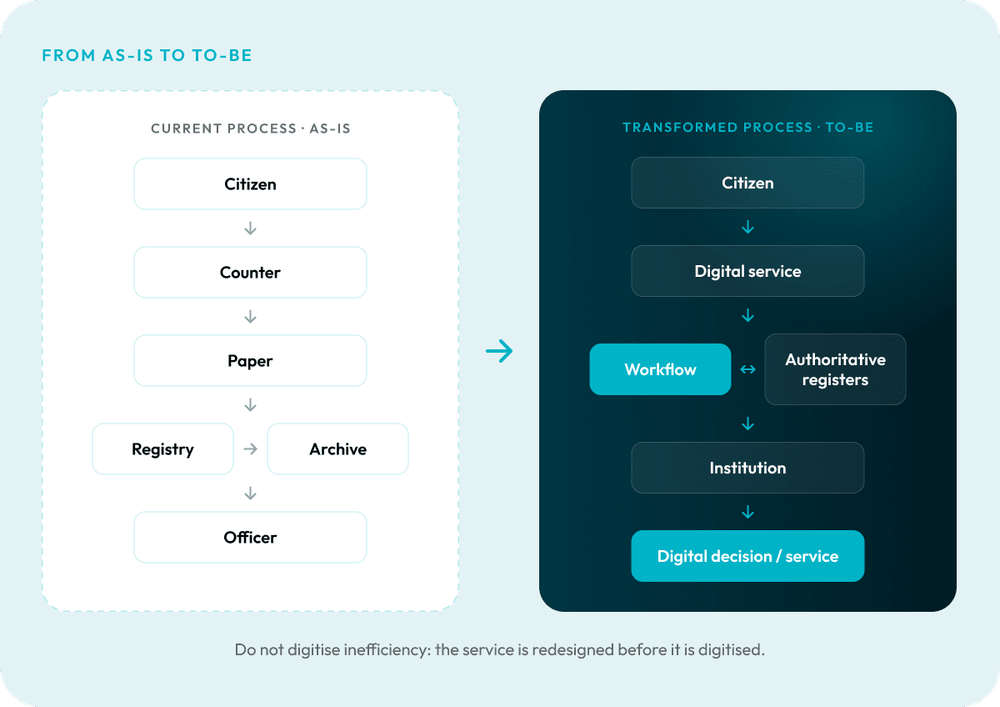
One of the central ideas behind the ITO Digital Transformation Framework is simple: do not digitise inefficiency.
Before designing a new system, we need to understand the existing process — the AS-IS state.
Who performs each activity? What information is required? Where does that information originate? Which steps are manual? Where is information entered multiple times? Which decisions require institutional authority? Where do delays occur?
Once that is understood, we can design the TO-BE process.
Some steps may be eliminated. Others can be simplified. Existing registries can be integrated instead of creating new databases. Repetitive activities can be automated. Information can move between systems instead of being manually transferred by people.
Only then do we define the technology required to support the new process.
Seven stages of digital transformation
Based on our experience implementing digital platforms across government and mission-critical environments, we structured the ITO Digital Transformation Framework around seven stages:
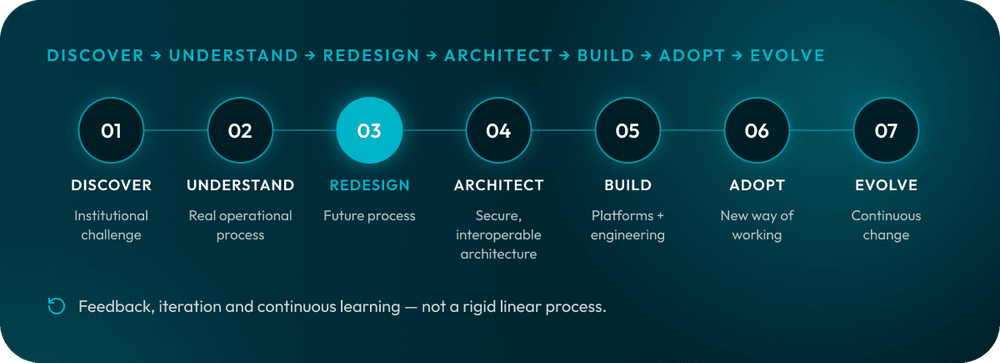
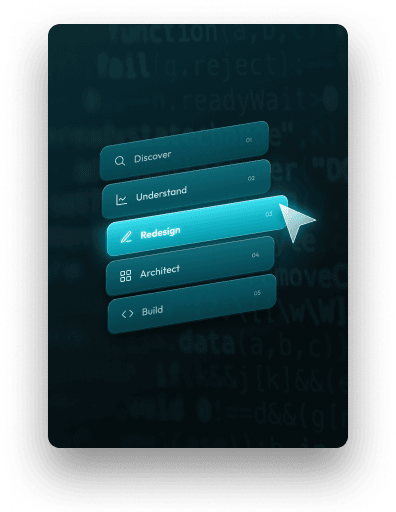
Discover establishes the institutional challenge, objectives, stakeholders and constraints.
Understand maps the real operational process, information flows, systems and dependencies.
Redesign creates the future process by eliminating unnecessary steps, simplifying workflows, integrating information and identifying appropriate opportunities for automation.
Architect translates the transformed process into a secure, interoperable and sustainable technology architecture.
Build combines reusable platform capabilities, integrations and project-specific engineering to create the required digital service.
Adopt ensures that transformation does not end with software deployment. Users, administrators and operational teams need to successfully transition to the new way of working.
Evolve recognises that digital transformation is continuous. Institutions, legislation, technology, security threats and user expectations will continue to change.
These stages provide structure, but they are not intended to turn transformation into a rigid linear process. Real projects require feedback, iteration and continuous learning.
Five foundations beneath every transformation
The seven stages describe how we approach transformation.
Five foundations define what every transformation should be built upon:
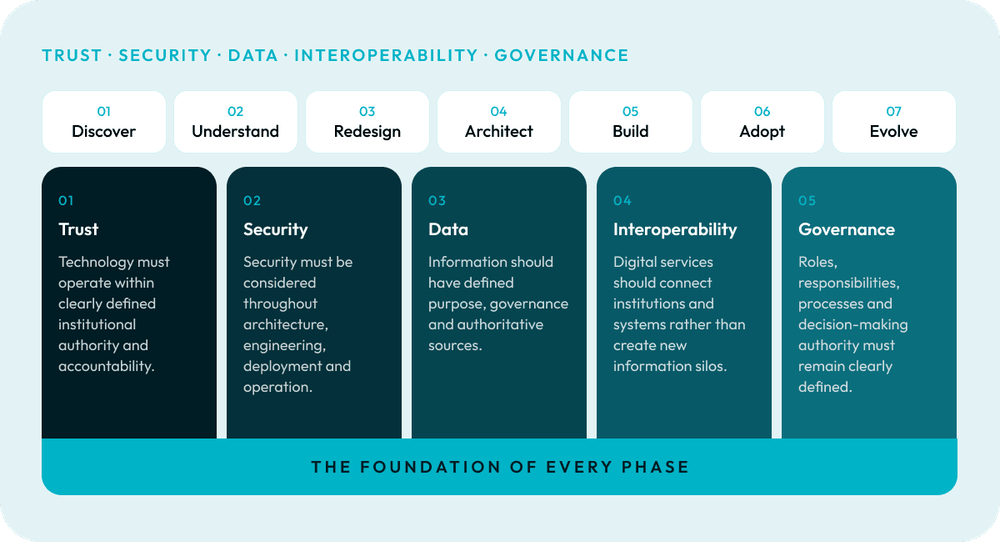
Trust means that technology operates within clearly defined institutional authority and accountability.
Security must be considered throughout architecture, engineering, deployment and operation rather than added at the end of a project.
Data must have a defined purpose, governance model and authoritative source.
Interoperability allows institutions and existing systems to work together instead of creating new digital silos.
Governance ensures that roles, responsibilities, processes and decision-making authority remain clearly defined as technology changes the way work is performed.
These foundations are particularly important when digital transformation affects public services, law enforcement, critical infrastructure or other environments in which technology supports institutional authority.
Integration before duplication
Another principle behind the framework is that digital transformation should not automatically result in new copies of information that already exists elsewhere.
Government institutions frequently operate authoritative registries containing identity, vehicle, document, geographic, financial or other information.
Where appropriate, modern digital services should securely interact with these authoritative sources rather than repeatedly asking users or employees to provide the same information.
This is why interoperability is not simply a technical feature of an ITO solution. It is an architectural principle.
The objective is to move from isolated applications toward connected digital ecosystems.
Platforms accelerate transformation, but they do not define it
ITO has developed reusable platforms for different areas of digital government, public safety, institutional collaboration, asset management, mobility, citizen services and IoT.
Platforms allow us to reuse proven capabilities and accelerate implementation.
But our Digital Transformation Framework is intentionally product-independent.
The transformation challenge determines the technology — not the other way around.
Depending on the project, an existing ITO platform may provide most of the required foundation. In other cases, transformation may require new integrations, project-specific development or cooperation with third-party technologies.
Our role is to engineer the appropriate solution around the institutional objective.
Go-live is not the finish line
One of the easiest metrics in an IT project is whether the software has been deployed.
It is also one of the least useful measures of digital transformation.
A system can be technically operational while employees continue using old processes, information remains duplicated, integrations are unused and citizens experience little improvement.
For that reason, the ITO Digital Transformation Framework treats adoption and evolution as part of the transformation itself.
The better questions are:
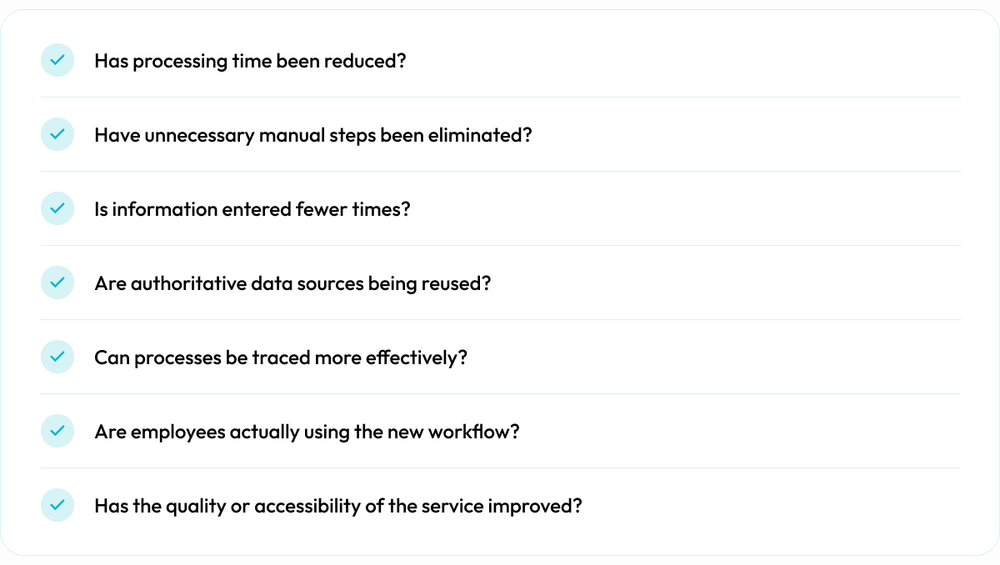
These are transformation outcomes.
Software deployment is only one milestone on the way to achieving them.
Engineering digital transformation
After years of building systems for complex institutional environments, one lesson has become increasingly clear to us:
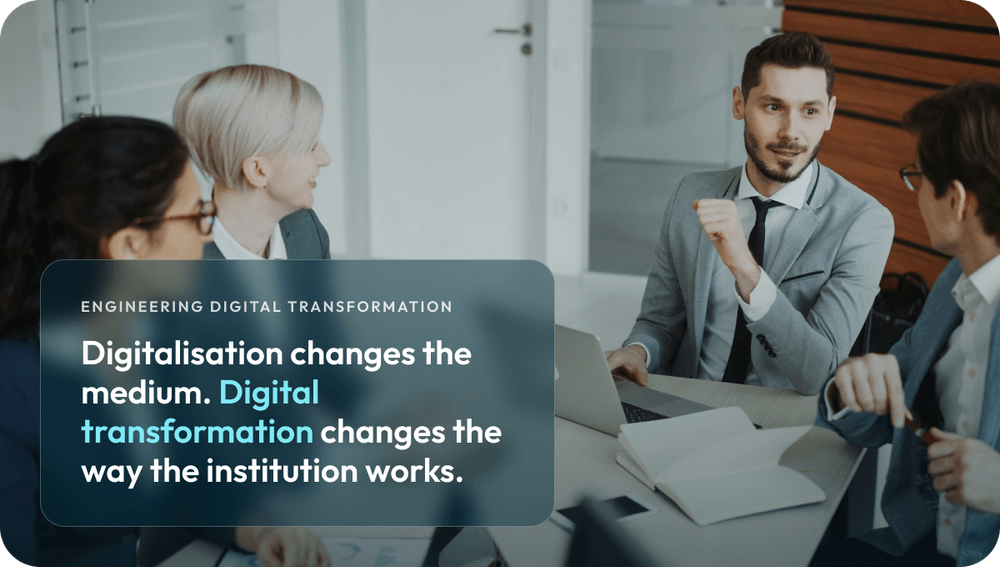
The ITO Digital Transformation Framework formalises that experience into a methodology that can be applied from the earliest business analysis through architecture, engineering, implementation, adoption and continuous improvement.
The complete framework describes the seven transformation stages, their underlying principles and the methodology we use to move from an institutional challenge toward a sustainable digital service.
THE COMPLETE FRAMEWORK
Read the ITO Digital Transformation Framework
Seven transformation stages, five foundations and the methodology behind sustainable digital services. 18 pages · PDF · EN & HR.